Ok, it’s more than obvious now – search behaviour is changing. More people are getting answers directly from AI tools…ChatGPT, Google AI Overviews, Perplexity, Bing Copilot…without clicking through to a website. If your content isn’t structured to be found and understood by these tools, well I have some bad news – you’re invisible to a growing part of your audience.
This is what Answer Engine Optimization (AEO) addresses. Yup. AEO is the new SEO. And no – it’s not a trend to chase. It’s a practical shift in how you write and structure content…and it’s not that scary, no worries!
I’m still trying to get my head around all the hacks, tactics and new AEO tools, but let me guide you through the basics, one step at a time ⬇️.
What is AEO?
| AEO stands for Answer Engine Optimization. It’s the practice of structuring your content so that AI tools and search engines can find, extract, and use it to answer user questions directly. Traditional SEO helps your page rank in search results. AEO helps your content become the answer ➡️ in AI-generated responses, featured snippets, voice search results, and knowledge panels. 💡 The core idea: write content that answers questions clearly, directly, and in a way that’s easy for both humans and machines to understand. |
Why does AEO matter?
I hope that we all agreed that search has changed. A significant portion of searches now end without a click. People get their answer on the results page itself, from AI Overviews, featured snippets, or direct AI tools like ChatGPT.
This is quote a game changer for small businesses and marketing managers. Yup, this means three things:
- Visibility is shifting. Being on page one isn’t enough if AI tools are pulling answers from other sources. Your content needs to be the source.
- Authority is built differently. Being cited by an AI tool signals credibility – to both machines and the people using them.
- The bar for content quality is higher. Vague, generic content won’t be extracted. Clear, structured, direct answers will.
TL;DR: AEO isn’t about replacing SEO. It’s about making your content work harder in a changed environment.
AEO vs SEO: what’s the difference?
| Traditional SEO | AEO |
| Rank higher in search results | Become the answer itself |
| Optimise for keywords | Optimise for questions |
| Drive clicks to your site | Appear in AI responses |
| Focus on domain authority | Focus on content clarity |
| Measured by traffic | Measured by citation and visibility |
They’re not opposites. Good AEO tends to support good SEO: structured, clear, authoritative content performs well in both contexts. Think of AEO as a layer on top of your existing content strategy, not a replacement for it.
…but if you’ve been in SEO for a while, you’ll probably agree that this isn’t a completely new playbook. The fundamentals haven’t changed, but the way content gets discovered has. AEO is simply SEO adapted to an AI-first search experience.
How does AEO work?
AI tools scan and process large amounts of web content. So, when someone asks a question, the AI looks for content that:
- Directly answers the question (not circles around it)
- Is clearly structured (headings, lists, short paragraphs)
- Is specific and factual (not vague or promotional)
- Comes from a credible, consistent source
- Uses the same language the user uses when asking

The AI isn’t impressed by clever writing or brand voice. It’s looking for clear information it can extract and use. That’s what AEO helps you create.
How to do AEO: a practical approach
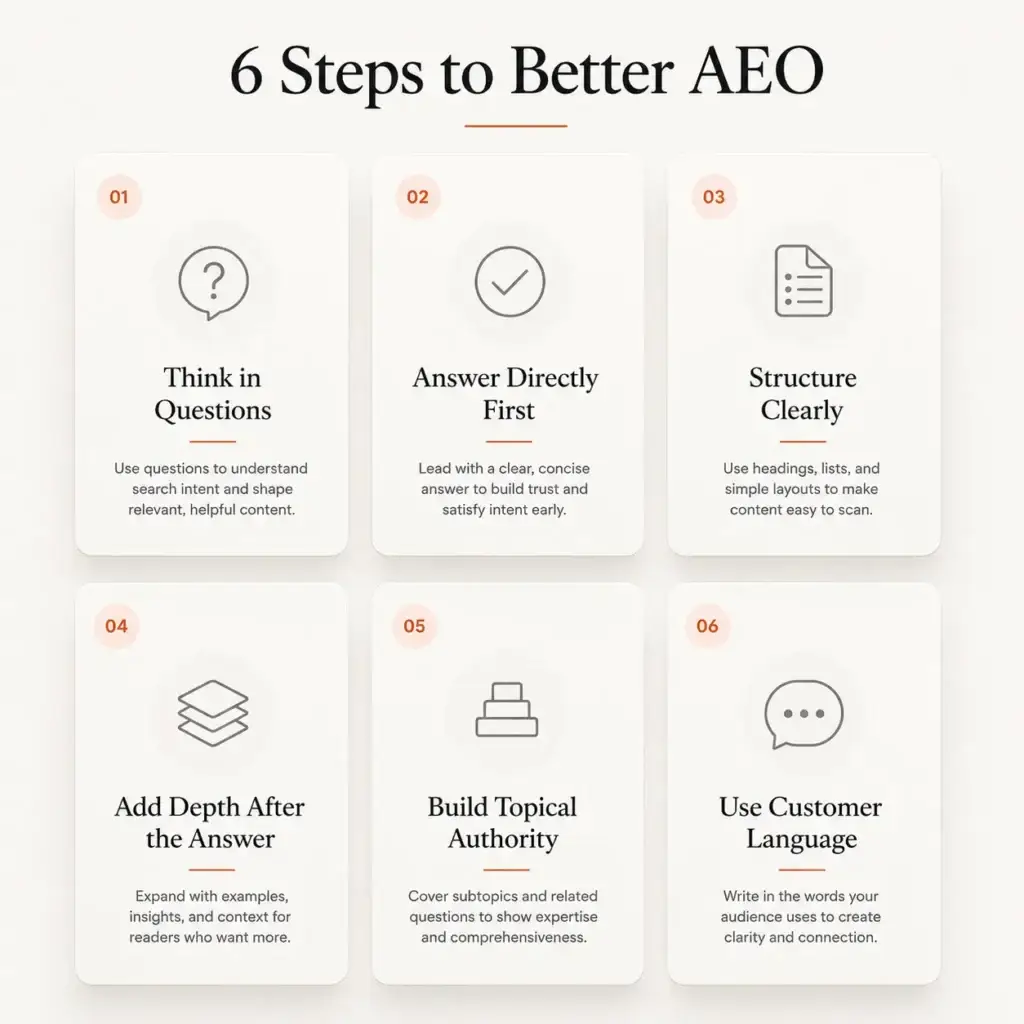
Here are the steps that actually make a difference.
1. Think in questions, not topics
Instead of writing about “social media marketing,” write content that answers: “How often should a small business post on social media?” or “What’s the best social media platform for a local service business?” Real questions from real people are your starting point.
2. Answer directly – first
Put the answer at the top of each section. Don’t build up to it. AI tools pull the most direct, complete answer they can find. If yours is buried in paragraph four, it won’t be used. Lead with the answer, then expand.
3. Use clear, structured formatting
Break content into short sections with H2 and H3 headings. Use bullet points for lists. Use numbered steps for processes. Keep paragraphs to two or three sentences. This structure helps AI extract specific pieces of information cleanly.
4. Add depth after the direct answer
Give the answer first. Then explain the nuance, context, or exceptions. This makes your content useful for readers and quotable for AI. Shallow answers won’t be cited and they won’t build trust with your audience either.
5. Build topical authority over time
One well-optimised post won’t do much on its own. AEO rewards consistency. If your site covers a topic in depth, with multiple pieces that link together and answer related questions, AI tools are more likely to treat it as a reliable source on that subject.
6. Use language your audience actually uses
Write the way your clients ask questions, not the way your industry talks about them. “How do I get more customers online?” is what a small business owner asks. “Digital customer acquisition strategy” is what a consultant writes. Match the language to the question.
What good AEO looks like: examples
Question: “How long does it take to see results from SEO?”
| Less effective SEO is a long-term strategy that requires patience, consistent effort, and a well-rounded approach including on-page optimisation, link building, and technical improvements. Results can vary significantly depending on your industry… | More effective Most businesses see early SEO results within 3 to 6 months, and more significant growth between 6 and 12 months. The timeline depends on how competitive your niche is, your existing domain authority, and how consistently you publish quality content. |
The second version leads with a specific, extractable answer, then adds context. That’s what AI tools look for AND what readers find more useful.
Question: “What is a content strategy?”
| Less effective Content strategy is one of those terms that gets thrown around a lot in marketing circles. It can mean different things to different people, but at its core, it’s really about how you plan and manage your content… | More effective A content strategy is a plan that defines what content you create, who it’s for, and how it supports your business goals. It covers the topics you’ll cover, the formats you’ll use, where you’ll publish, and how you’ll measure success. |
Common mistakes to avoid
- Writing for keywords, not questions Keyword-stuffed content rarely answers a question clearly. Focus on the intent behind the search, not just the phrase itself.
- Burying the answer Long introductions, background context, and storytelling before the actual answer make content harder to extract. Put the answer first.
- No clear structure Walls of text don’t get cited. Use headings, bullet points, and short paragraphs. Structure is not optional for AEO.
- Being too vague to be useful “It depends” is not an answer. Provide specific, concrete information. Add nuance after the direct response, not instead of it.
- Publishing once and stopping AEO is built through consistent, quality content over time. A single optimised post is a start, not a strategy.
The bottom line
AEO isn’t about producing more content. It’s about producing clearer content.
Most of what makes content work for answer engines also makes it work for actual humans: a direct answer, clear structure, specific information, and consistent publishing on topics you know well.
If your marketing feels scattered, AEO is a good lens to look through. It forces you to get specific about who you’re writing for, what questions they’re asking, and whether your content actually answers them.
That discipline, knowing what to say and how to say it clearly, is what makes content useful. And useful content is what gets found, shared, and cited.
Most businesses don’t have a content problem. They have a clarity problem. AEO is one way to fix it.
…and it’s not that hard!